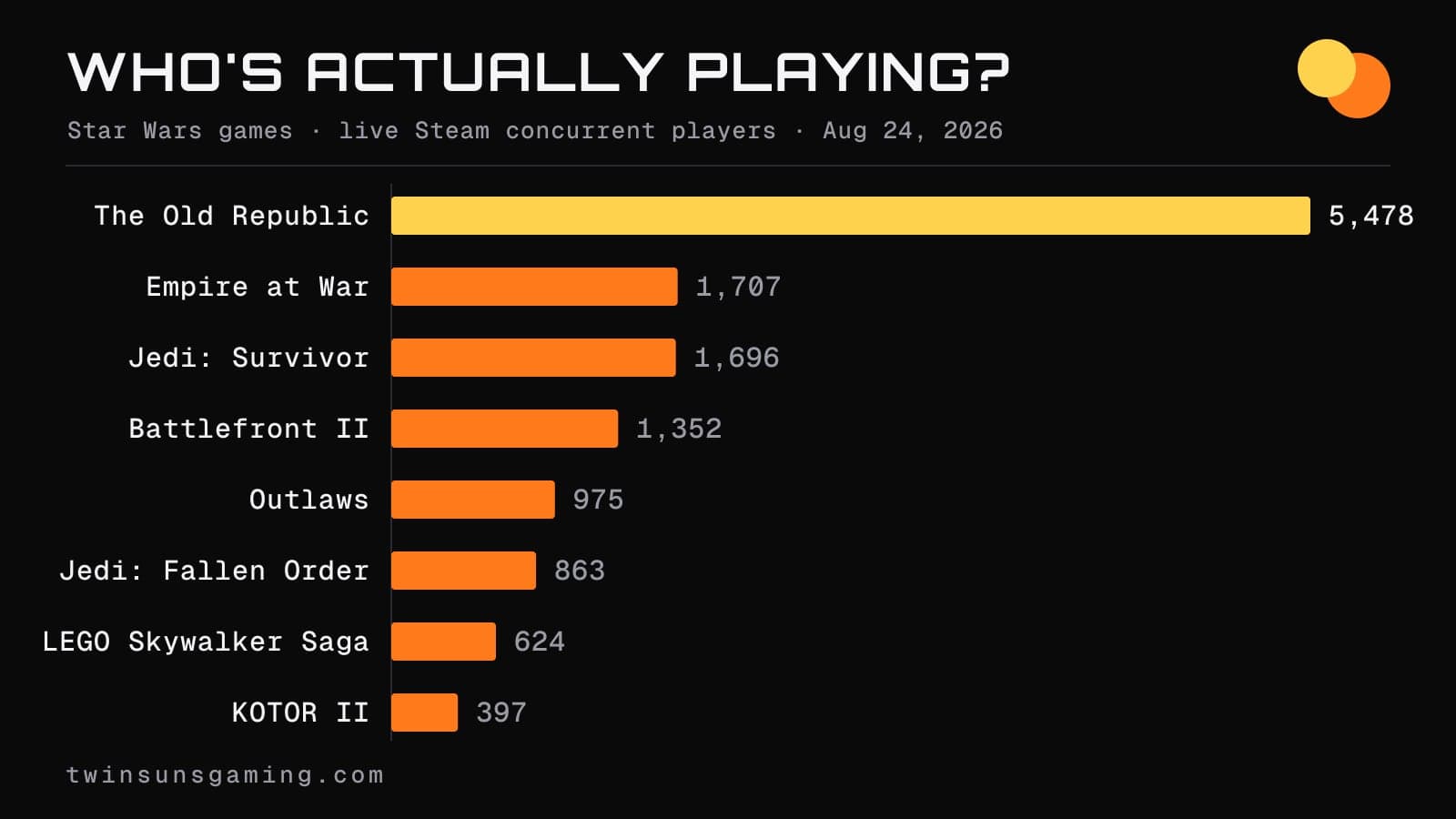
Three days before Zero Company arrives, we pulled the live numbers on every Star Wars game on Steam, plus Twitch viewership, to see where the galaxy's players actually are. Snapshot taken Monday, August 24 at 19:30 UTC, which is evening prime time in Europe and mid-afternoon in the US.
The short version: The Old Republic is far and away the most played Star Wars game on PC right now, a 2006 strategy game is quietly beating Jedi: Survivor, and if you want a multiplayer match tonight, exactly one shooter can promise you one.
The numbers
Concurrent players on Steam, with Twitch viewers for the same hour:
| Game | Steam players | Twitch viewers |
|---|---|---|
| The Old Republic | 5,478 | 443 |
| Empire at War | 1,707 | 5 |
| Jedi: Survivor | 1,696 | 174 |
| Battlefront II (2017) | 1,352 | 48 |
| Outlaws | 975 | 34 |
| Jedi: Fallen Order | 863 | 34 |
| LEGO Skywalker Saga | 624 | 10 |
| KOTOR II | 397 | 13* |
| KOTOR | 308 | 13* |
| LEGO Complete Saga | 211 | n/a |
| Galactic Battlegrounds Saga | 171 | n/a |
| Battlefront II (Classic, 2005) | 167 | n/a |
| Jedi Academy | 84 | n/a |
| Squadrons | 52 | 0 |
| Republic Commando | 43 | n/a |
| Battlefront (Classic, 2004) | 43 | n/a |
| Battlefront (2015) | 30 | 4 |
| Jedi Outcast | 26 | n/a |
| Battlefront Classic Collection | 19 | n/a |
| Episode I Racer | 8 | n/a |
| X-Wing Alliance | 1 | n/a |
What these numbers are (and aren't)
Steam counts are live concurrent players from Valve's public API, Steam only. Battlefront II, Outlaws, and SWTOR also have players on consoles or other PC launchers who don't show up here, so treat these as a floor, not a total. Twitch numbers are viewers, not players. The starred KOTOR figure is one shared Twitch category covering both games.
SWTOR is having a real moment
Five and a half thousand concurrent players on Steam alone puts The Old Republic ahead of the next three games combined, and that undercounts it: plenty of veterans still run the standalone launcher. The why is no mystery. The Legacy Reborn 7.9 update landed this month, and nearly every stream in the Twitch category is running drops right now, which is exactly the combination that pulls lapsed players back. A 14-year-old MMO topping the franchise chart in the same week a brand-new Star Wars game launches is a genuinely good sign for the health of this corner of gaming.
The Empire at War mod scene refuses to die
The number that made us double-check the API: Empire at War, from 2006, at 1,707 players, a nose ahead of Jedi: Survivor. There's no mystery here either if you've ever opened its Steam Workshop. Total-conversion mods like Thrawn's Revenge and Fall of the Republic have kept this RTS alive for two decades, and Petroglyph was still shipping official patches more than a decade after release. It remains the best value in Star Wars strategy, which is worth remembering during a week when everyone (us included) is fixated on a new Star Wars strategy game.
Can you actually get a multiplayer match tonight?
The practical question behind concurrent numbers. Going by this snapshot:
- Battlefront II (2017): yes. Over 1,300 players on Steam alone, plus the EA app and console crossplay population. Evening queues for the big modes fill fine, six years after the last content update.
- Battlefront (2015): on PC, not really. 30 players online at once can't sustain matchmaking. Console lobbies are reportedly healthier, but on PC treat it as a single-player nostalgia trip.
- Squadrons: no. 52 players spread across regions and modes means empty queues. Buy it for the excellent VR campaign, not the dogfights.
- The classics: surprisingly, sometimes. Battlefront II (2005) still shows 167 players and has an active community server scene, which is more multiplayer life than games a fraction of its age.
What this says about Thursday
Zero Company launches Thursday at 3pm UTC into a field where the most played Star Wars games are an MMO from 2011 and an RTS from 2006. That's not a weakness in the lineup; it's the pattern. Star Wars games with systems deep enough to live in keep their players for decades, while even good linear games settle into the mid-hundreds once the credits roll. A turn-based tactics game with permadeath and a 30-plus-hour campaign is aiming squarely at the live-forever category. Thursday evening, these baselines will tell us immediately how big its opening actually is, and we'll be watching the same numbers.