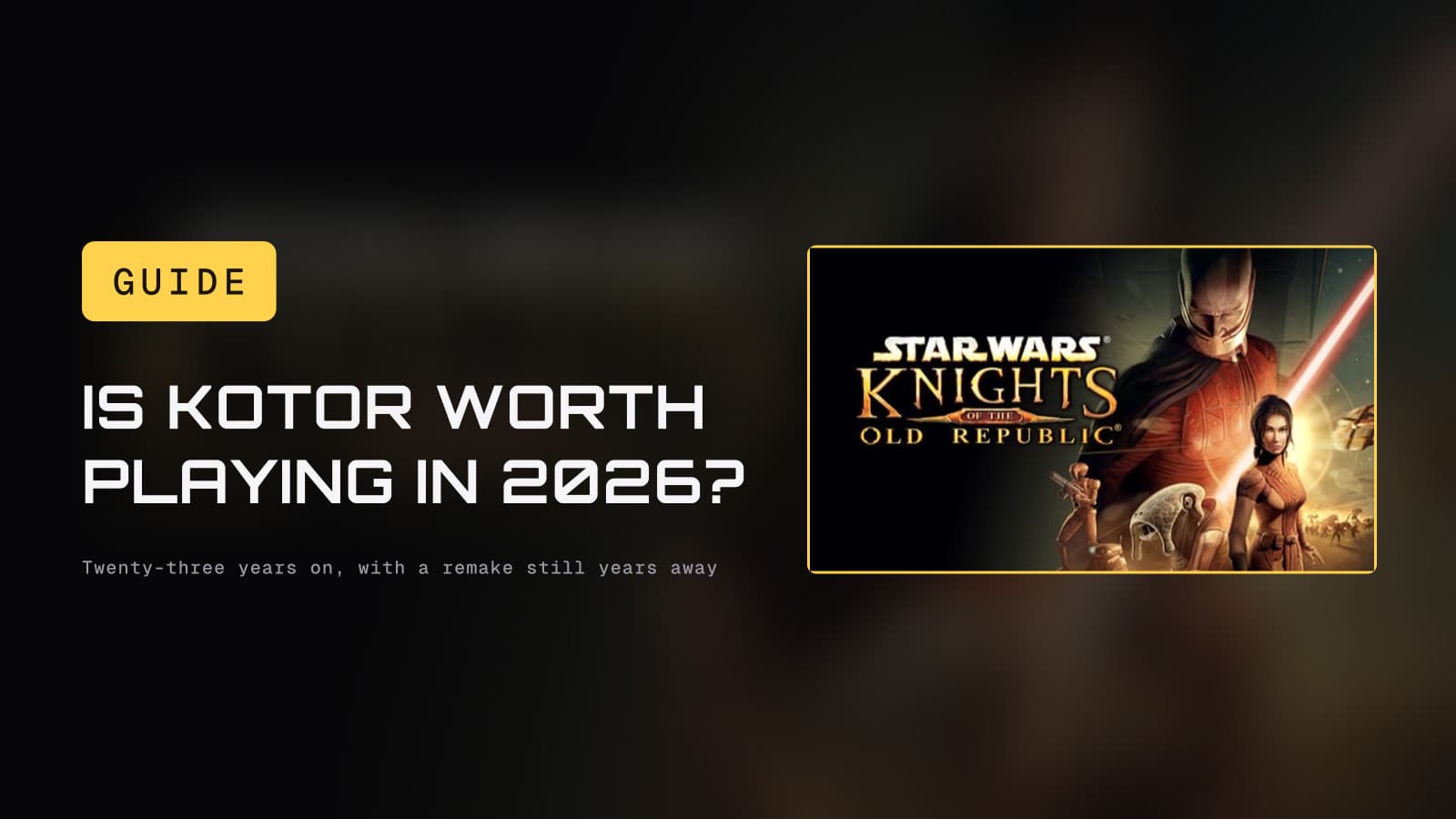
Yes. Buy the PC version for $9.99, install the Community Patch and a widescreen fix, and play it now rather than waiting for the remake, which Saber Interactive's own leadership has only ever mentioned in the same breath as its 2028 plans. That is the whole answer for most people. The rest of this page is the exceptions, the versions, and what actually holds up after twenty-three years.
Why the answer is still yes
Knights of the Old Republic has a Metacritic score of 94, the highest any Star Wars game has ever recorded, and our own all-time ranking put it first for reasons that had nothing to do with nostalgia: a 40-hour campaign with a twist that still lands, companions who argue with each other, and a light-and-dark choice system that BioWare built here before it built Mass Effect on the same bones. Nothing in Star Wars has done the role-playing part better since, including the studio's own sequel.
It is also still being played. Our tracker has counted the Steam version every two hours since August 24: it peaked at 394 concurrent players on a Sunday evening and sits in the 250 to 350 range most of the day, which for a 2003 game with no online component is remarkable. KOTOR II, incidentally, runs slightly higher, and we get to why below.
Do not wait for the remake
The remake was announced in September 2021 for PlayStation 5 and PC, moved from Aspyr to Saber Interactive in 2022, and has not shown a frame of gameplay since. The most recent word from anyone at Saber came in July, when the studio's new head Steve Allison, in a community Q&A, talked about "publishing plans for 2028" and listed "hopefully, KOTOR Remake" among them. He did not say it would release in 2028. He said it was among the things the company planned to be working on then.
Read that as intended: the game is alive, and it is years away. If you want to play KOTOR before the end of the decade, the original is the only option, and a ten-dollar RPG you finish in a month is not a purchase the remake's eventual arrival will make you regret.
Which version
| Platform | Price | Verdict |
|---|---|---|
| PC (Steam or GOG) | $9.99 | The one to buy. Mods fix everything below |
| Switch (Aspyr, 2021) | varies | Fine on a handheld; no mods, and the 2022 sequel port's bugs made people wary of both |
| Xbox (backward compatible) | disc or digital | The original 2003 experience, 4:3 and 720p-ish; works |
| iOS / Android | varies | Complete and surprisingly good with touch, but small text |
| Steam Deck | $9.99 | Valve rates it Playable; ProtonDB Gold on 174 reports; fix the resolution once |
The PC version is the choice because the problems the game has in 2026 are all fixable there and nowhere else. Out of the box on a modern Windows machine it runs at a 4:3 aspect with tiny UI, the movies can stutter, and it carries the bugs BioWare never patched: broken quest states, a few inaccessible conversations, some items that never spawn.
The two mods to install before you start
The KOTOR modding community keeps a maintained "mod build" that tells you exactly what to install and in what order, updated as recently as July 2026. If you install only two things, make them these:
- KOTOR 1 Community Patch (K1CP). A compilation of bug fixes, described by the community as being to KOTOR what the Restored Content Mod is to KOTOR II: it repairs broken quests, stuck conversations and inaccessible content without changing the design. Install it first, before anything else, because other mods expect it.
- A widescreen and UI fix. The game predates 16:9. The community build walks through the resolution patch and the high-resolution menu assets that stop the interface rendering at postage-stamp size on a 1440p monitor.
Everything past those two, the texture upscales, the character overhauls, the reflective saber blades, is taste. The build's spoiler-free list is the place to pick from, and the one rule it repeats is worth repeating: one game install, extract every mod before running its installer, and install in the listed order.
Two cautions. The Amazon Games version of KOTOR ships a modified executable that breaks the sound system and needs extra steps the build documents; buy on Steam or GOG instead. And none of this applies to Switch or mobile, which cannot be modded at all.
What holds up and what does not
Holds up: the writing, the companions, the twist, the pacing of the first twenty hours, and the way the dark side path is a genuinely different game rather than a rude version of the same one. The combat is turn-based under the hood, paused whenever you want, and it plays better with that in mind than if you treat it as an action game.
Does not: Taris is too long by about three hours, the combat animations are the same six clips for forty hours, and the game's idea of a hard decision is often a Persuade check. None of this stops anyone finishing it.
KOTOR or KOTOR II first
KOTOR first, then II. The sequel assumes you know who Revan is and what happened on the Star Forge, and its best material is a response to the first game's ending. Play II with the Restored Content Mod, which is why its Steam count runs higher than the original's in our tracker: the modded sequel is a better game than the one Obsidian was allowed to ship in 2004. But it is a better game because of what it does to the first one, so play them in order.
Who should skip it
If you need modern combat to stay engaged, KOTOR will lose you at Taris. If you played it in 2003 and remember the twist, the second run is still good but the first twenty hours are a long walk to a surprise you already know. And if a 4:3 game with 2003 textures is a dealbreaker even after the mods, Jedi: Survivor is the modern Star Wars single-player game to spend the money on instead.
For everyone else: ten dollars, two mods, and a month of evenings. It is still the best Star Wars game ever made, and the numbers we count every two hours say a few hundred people are finding that out on any given night.