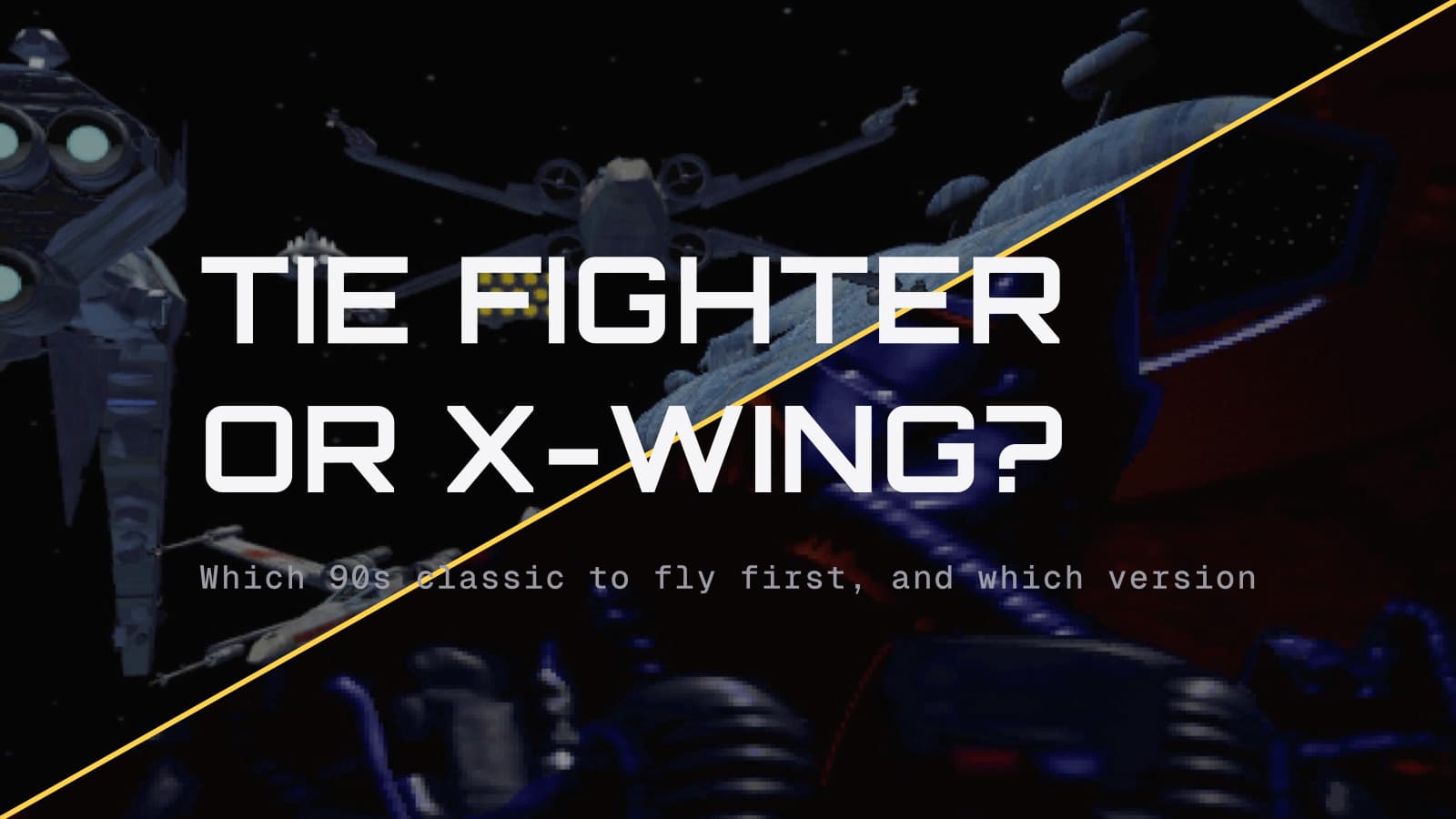
TIE Fighter is the better game. If you are only going to play one, play that, on GOG, in the 1995 CD version. It is X-Wing's engine a year later with the rough edges filed off, a better story, and more to do in the cockpit. The one reason to start with X-Wing instead is if you already know you will play both: X-Wing comes first in the story, and going back to it after TIE Fighter feels like a downgrade in a way that going forward never does.
Both games are $9.99 on Steam and GOG, and both are $4.99 on GOG until October 7, so the price is not the deciding factor. The rest of this is the detail behind that call.
The two games in one paragraph each
X-Wing came out in February 1993 from Totally Games, Lawrence Holland and Edward Kilham's studio, published by LucasArts. You fly for the Rebellion across three tours of duty, 12 to 14 missions each, ending as Luke Skywalker on the Death Star trench run. The Imperial Pursuit and B-Wing expansions followed later in 1993. Its launch shipment of 100,000 copies sold out in a weekend.
TIE Fighter followed on July 20, 1994, from the same studio, built on X-Wing's engine. You fly for the Empire, starting just after the Battle of Hoth. The base game has seven tours of duty, and the Defender of the Empire and Enemies of the Empire expansions add three each, thirteen in all. It is first in our space combat ranking and first in our 1990s ranking. X-Wing is third and fourth on those lists.
Story and campaign: TIE Fighter, clearly
X-Wing's story is the film you already know, told from the edges. It builds to the Death Star, which is a great final mission and not much of a surprise.
TIE Fighter's story is the reason people still talk about it. You spend most of it fighting pirates, a civil war and traitors inside the Imperial Navy, often under Grand Admiral Thrawn rather than Vader, and the game presents the Empire as the side keeping order. The base campaign ends with you stopping a coup against the Emperor. On top of the normal briefing, a member of the Emperor's Inner Circle often gives you a second, secret briefing with optional objectives, and completing those earns you rank in a parallel hierarchy. That second layer is what makes every mission feel like it has a story behind it.
Reviews at the time saw the upgrade. Gamebytes listed numerous improvements over X-Wing, and its one real complaint was the ending.
Flight model and systems: the same engine, better tools
Both games run on the same core: shields, lasers and engines drawing from one power supply, so charging weapons slows you down, and shields and hull take damage separately. If you learn it in one, you know it in the other.
TIE Fighter adds the things you miss the moment you go back:
- Targeting components. You can lock onto a capital ship's shield generators and turrets individually instead of chipping at the whole hull.
- A 3D target display that shows the target's model and which way it is facing.
- Objectives and message log in flight, so you can check what the mission wants without guessing.
- Repair order. When hull damage knocks systems out, you choose which gets fixed first.
- Beam weapons on some craft, with their own power to manage.
The trade is the ship roster. X-Wing gives you the A-wing, X-wing, Y-wing and, with its expansion, the B-wing. TIE Fighter is the Imperial line, which means plenty of missions in a TIE fighter with no shields at all.
Difficulty: X-Wing is the one people warn you about
X-Wing's difficulty was its most-cited problem in 1993 and it has not aged into charm. Computer Gaming World's review liked the flight model and disliked having to find a precise "solution" to each mission. Compute! called its rigid structure, with no margin for error, "controversial." Next Generation's 1996 review of the Mac port was still docking it for the same rigid difficulty.
In both games you advance by completing a mission's primary objectives, and in both you can retry a failed mission as often as you like. What changed is the help around that. TIE Fighter's in-flight objective screen tells you where you stand, component targeting makes capital ship attacks less of a slog, and its reviews complained about other things: Edge found the missions repetitive and did not enjoy fighting for the Empire.
If you are new to flight sims, that is the strongest argument for starting with TIE Fighter.
The versions, and which store has which
Both games exist in three PC versions, and the best one for each is the middle one.
| X-Wing | TIE Fighter | |
|---|---|---|
| Original DOS | 1993, floppy, 320x200 | 1994, floppy, 320x200 |
| Collector's CD-ROM (DOS) | 1994, on TIE Fighter's engine with Gouraud shading, both expansions, voiced briefings and radio | 1995, 640x480, both expansions, more voice work, enhanced cutscenes |
| Windows (1998) | X-Wing vs. TIE Fighter engine, 3D acceleration and textures | Same |
| Music | iMUSE, reacts to the fight (DOS versions) | iMUSE, reacts to the fight (DOS versions) |
The 1998 Windows versions, from the X-Wing Collector Series, look sharper and lose the most important thing: the reactive iMUSE score is replaced by looped recordings of the film soundtrack. They also need a controller or joystick to start, which Steam's own store pages say for both games. The DOS versions play on mouse and keyboard.
Where to buy, as of September 26:
- TIE Fighter: GOG. GOG's package includes the 1995 CD version, added in April 2015. Steam's lists only the 1994 and 1998 builds, and on Steam the Enemies of the Empire missions come only with the 1998 one. That makes GOG the right store for this game. $4.99 there until October 7, $9.99 on Steam.
- X-Wing: either, GOG preferred. GOG lists all three versions. Steam's page lists the 1993 and 1998 versions, although our X-Wing guide found the CD build in the Steam install files. Same $9.99 list price, $4.99 on GOG until October 7.
GOG updated both packages in April 2025 with a DOSBox pass for Windows 10 and 11 and cloud saves. The full store rundown is in where to buy old Star Wars games.
Playing them on a modern PC
Both run on Windows 11 through the DOSBox builds in the store packages, and both are better with a cheap USB stick. Each also has a free fan route:
- X-Wing has XWVM, a rebuild of the game in Unity that loads the missions and assets from your own copy. It is alpha software. Setup is in our X-Wing guide.
- TIE Fighter has the TIE Fighter Total Conversion, which rebuilds the whole game inside X-Wing Alliance and reached version 1.4 this year. Setup is in our TIE Fighter guide.
Neither changes the verdict. They make both games easier to live with.
Who should pick which
Pick TIE Fighter if you want the best one, you have never played a flight sim, or you are here for the story. It has the better campaign, the better cockpit tools, and none of the difficulty complaints that followed X-Wing.
Pick X-Wing if you want to fly the Rebel ships, you want the Death Star run, or you enjoy a sim that makes you work for every mission. It is the harder game and it has the more famous finale.
The case for playing both, in order
If you have the time, play X-Wing first and TIE Fighter second. The stories run in sequence, from before A New Hope to the eve of Return of the Jedi, and seeing the war from both cockpits is half the point of the pair. The mechanics also stack cleanly: everything you learn in X-Wing carries over, and each thing TIE Fighter adds lands as a fix you felt the need for. Played the other way round, X-Wing is the same game with tools taken away.
At $4.99 each on GOG until October 7, the pair costs $9.98.
What next
After these two, the series went two ways. X-Wing vs. TIE Fighter (1997) was built for multiplayer and shipped without a story campaign; its Balance of Power expansion, bundled in the store version, added one. X-Wing Alliance (1999) is the last and biggest of the sims, and the one the modding scene still builds on.
The details
- Release dates, developers, campaign structure, TIE Fighter's gameplay additions and the version histories come from the Wikipedia entries for both games, which cite the Los Angeles Times for TIE Fighter's July 20, 1994 date and GameSpot for the Collector's CD-ROM and 1998 changes.
- The review quotes are from Computer Gaming World (June 1993), Compute! (August 1993), Next Generation (August 1996), Gamebytes (1994) and Edge, as summarized in those entries.
- Store contents, prices and the joystick requirement come from the Steam and GOG store pages, checked September 26, 2026. GOG's staff notes date the CD versions' arrival to April 28, 2015.
- XWVM and the TIE Fighter Total Conversion details come from each project's ModDB page.