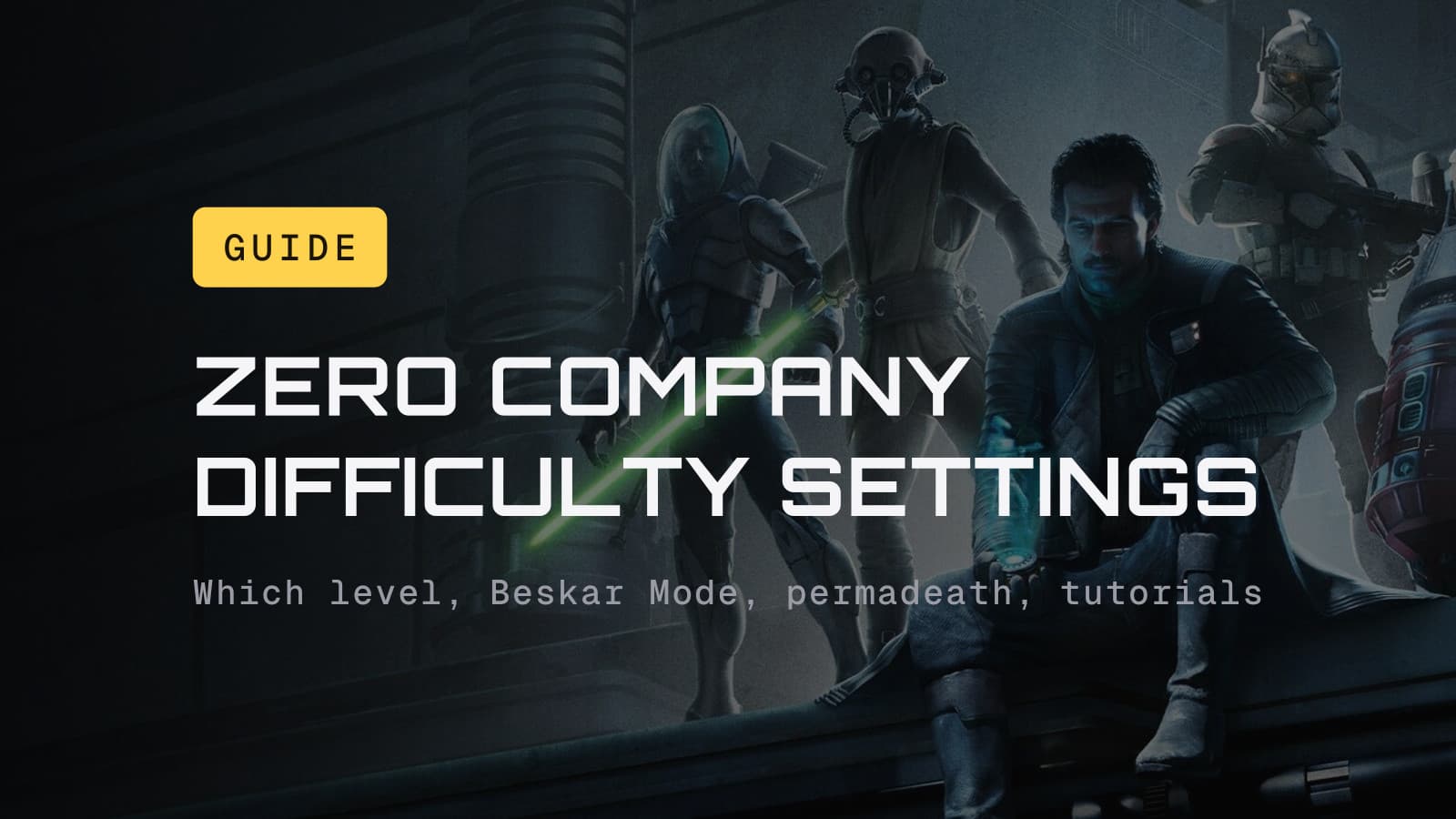
Star Wars: Zero Company puts four difficulty levels and three toggles in front of you before you play a single turn, and its in-game descriptions are more honest than most games bother with. Two things they leave out are worth knowing first: Hard and Expert take away a base facility and change your squad's starting relationships, and the two scariest-sounding toggles do completely different jobs.
TL;DR
Never played a tactics game: Normal, tutorials on, permadeath on, Beskar Mode off. Finished an XCOM: Hard. Want the hardest honest run: Expert with Beskar Mode, on a second campaign rather than your first. Difficulty is the only setting here the game promises you can change later.
The four difficulty levels
Difficulty can be changed at any time outside of combat. That makes it the lowest-stakes decision on the screen, so start one notch above comfortable and drop down if a mission stops being fun.
| Level | Intended for | What changes |
|---|---|---|
| Story | Players who want the story with minimal challenge, or no tactics-game background at all | Your actions deal increased damage; enemies are significantly easier, with much lower accuracy and damage |
| Normal | Players new to tactical games | Enemies deal normal damage at normal accuracy, weapon ranges are generous, and mistakes are easy to recover from |
| Hard | Players familiar with tactics games, or anyone wanting more than Normal | Enemies are tougher and hit harder, effective weapon ranges are reduced, starting bond levels between Operators are lower, and the Bacta Tank is disabled |
| Expert | Players with real tactics expertise wanting the game's highest challenge | Everything Hard does, more of it: greatly enhanced enemy damage, greatly reduced weapon range, much lower starting bonds, no Bacta Tank |
Story is a genuine story mode, not a slightly softer Normal. It buffs your damage on top of nerfing the enemy, so fights bend toward you from both directions. If you're here because it's Star Wars and the Clone Wars squad premise sold you rather than the genre, this is a legitimate way to play and nobody should talk you out of it.
Normal is the default and the right first campaign for most people. Note what the game says it does: generous weapon ranges, and mistakes that are easy to recover from. Both of those get taken away later, and they're the two things that make a tactics game readable while you're still learning its grammar.
Hard is the real jump on this list, and the reasons that matter most happen outside of combat. See below.
Expert turns range into the central problem. When effective weapon range is "greatly reduced," holding a comfortable line stops working and you have to move into danger to deal damage at all. The game's own copy says careful tactics and planning are crucial, which is the polite version of: you will lose Operators.
The two things Hard and Expert quietly take away
Buried in both descriptions are two changes that have nothing to do with hit chance:
- Lower starting bond levels between Operators. Bonds are a squad-relationship system, so beginning a campaign with them lower means the payoffs they unlock arrive later, if at all. Every Hard or Expert run starts colder than a Normal one.
- The Bacta Tank is disabled. The settings screen names it without explaining it, and at roughly an hour in we haven't gone deep enough to describe exactly what it restores or how often. What we can say is why it matters more than the damage numbers: injuries are the currency of death in this game, and switching off a healing option changes the math on every mission after the one where somebody gets hurt.
That's the real gap between Normal and Hard. The damage numbers you feel in the first firefight; these two you feel in hour twelve.
Beskar Mode and permadeath are separate switches
The names blur together and the settings sit next to each other, but they govern different things.
Permadeath (on by default) is the Operator rule. An Operator who takes a third Injury dies permanently. That's the whole mechanic, and it's the number worth remembering: injuries stack, three is fatal, and the game was, in its own words, crafted with the intention that Operators can die. Turning it off stops that third injury from being final. How Injuries heal, who can die and how to keep everyone: our permadeath guide.
Beskar Mode (off by default) is the save-file rule. It keeps a single persistent save that updates constantly and removes manual saving, so choices become permanent and disasters can't be reloaded away. It also adds hard campaign-enders that permadeath alone doesn't have: if Hawks dies, another critical squad member dies, or a crucial mission is failed, the run is over.
So the combinations look like this:
| Permadeath off | Permadeath on | |
|---|---|---|
| Beskar off | Operators survive their third injury; reload whenever | Operators die for good, but a bad mission can be reloaded (the default game) |
| Beskar on | Losses stick because you can't reload, but Operators aren't killed by injuries | Full ironman: no reloads, permanent deaths, and a losable campaign |
Only difficulty is advertised as reversible
The screen explicitly says difficulty can be changed at any time outside of combat. It makes no such promise about Beskar Mode, permadeath, or tutorials. Treat those three as decisions you make once, and pick them before you start rather than mid-campaign.
Our take on permadeath: leave it on. The designers built the campaign expecting Operators to die, which means the squad management, the recruiting, and the bond system are all balanced around loss being a real possibility. Turning it off is a reasonable accessibility choice if losing a favorite would make you stop playing, and there's no shame in that. Just know you're playing a slightly different game than the one that was designed.
Our take on Beskar Mode: not on your first campaign, whatever your XCOM credentials are. A launch-week save with no manual backup is a bet on the game's stability as much as on your tactics, and we hit two crashes in our first 50 minutes. Beskar Mode is a fantastic second run, once you know the mission structure and the patches have landed. The first one, 1.1 on September 9, fixed a Beskar Mode crash and a bug that temporarily deleted Beskar saves, which takes some of the risk out (what else it fixed).
Show Tutorials
On by default, recommended by the game for first-time players, and it shows tutorials throughout the story rather than only in the opening hours. Leave it on for a first campaign even if you've played every XCOM there is. This game has its own Operator, bond, and injury systems, and there's no cost to reading a popup you already understand. Turn it off on run two, when the prompts have become interruptions.
What we're running
Normal, permadeath on, Beskar Mode off, tutorials on, for the first campaign and the review playthrough. That's the configuration the game presents as its intended experience, and reviewing anything else first would tell you about our preferences instead of the game's design.
A word on where this comes from: everything above is drawn from the game's own options screen plus a first session on launch day, so treat the descriptions as fact and the recommendations as an early read. Once we've finished a campaign we'll know whether Normal actually holds up for a genre newcomer or whether it softens too far, and we'll say so here. Deeper tactics guides follow the review, and the Zero Company hub collects everything as it lands.